
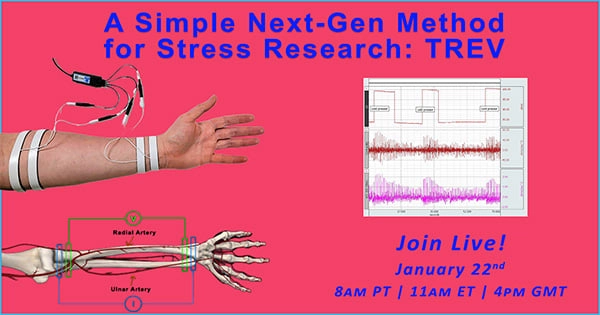
TREV (Trans-radial Electrical Bioimpedance Velocimetry) is an emerging bioimpedance technique that measures dynamic cardiovascular indexes such as velocity, acceleration, and contractility by recording impedance changes in the forearm. Unlike conventional transthoracic methods, which require complex torso electrode placement and are sensitive to breathing and movement, TREV’s forearm approach yields robust beat-by-beat data with simplified setup and enhanced signal stability.
By enabling high-resolution monitoring of SNS responses and cardiovascular dynamics, TREV provides investigators with advanced tools for stress research, autonomic function studies, and integrated physiological analysis.
Trans-radial Electrical Bioimpedance Velocimetry offers researchers a practical alternative to traditional transthoracic impedance methods, improving data quality and participant comfort while minimizing motion and ventilation artifacts.
This webinar advances beyond introductory theory to demonstrate how TREV integrates into real-world stress research workflows. The session covers:
