
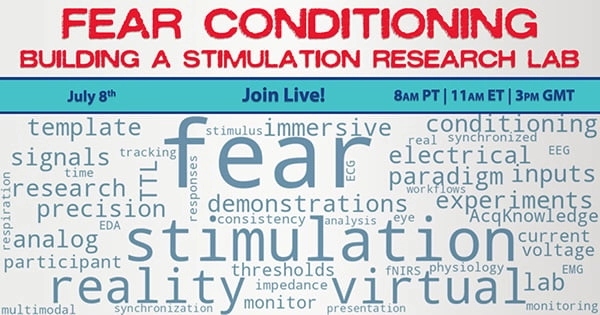
Fear conditioning remains one of the most widely used experimental paradigms for investigating learning, memory, emotion, anxiety, and trauma-related disorders. This webinar provides researchers with practical guidance for designing and equipping a high-quality fear conditioning laboratory capable of delivering reliable, synchronised physiological and behavioural data.
Participants will learn how to integrate stimulus presentation with multimodal physiological recording, including skin conductance (EDA/GSR), electromyography (EMG), electroencephalography (EEG), heart rate variability (HRV), respiration, eye tracking, and event synchronisation. The webinar also covers electrical stimulation hardware, experimental timing, data synchronisation, and best practices for acquiring reproducible research-grade measurements.
Designed for researchers in psychology, neuroscience, cognitive science, psychiatry, and behavioural medicine, this session demonstrates how modern data acquisition systems can be combined with stimulus presentation software to create flexible and scalable fear conditioning experiments.
Whether you are establishing a new psychophysiology laboratory or upgrading an existing research setup, this webinar offers valuable insights into hardware selection, experimental design, physiological signal acquisition, and synchronised multimodal data collection for fear learning and extinction research.
Topics include:
Join this webinar to discover practical strategies for developing robust fear conditioning experiments and advancing research into learning, emotion, anxiety, and stress-related disorders.
